
Research
My research interests are in homotopy theory, motivated from the chromatic perspective, and the tools I use are often computational. Here are some things that I have been interested in recently.
- periodicity in stable motivic homotopy theory
- generalized Adams spectral sequences
- redshift and blueshift
- motivic invariants over more general base schemes
I have written user’s guides to some of my papers that you can check out here.
Preprints/publications
8.C-motivic periodic self-maps
We construct a plethora of finite motivic spectra and identify their minimal periodic self-maps.
7.Motivic K-theory cooperations over the rationals
We compute the cooperation algebras for motivic integral cohomology, algebraic K-theory, and hermitian K-theory over all p-adic fields and the rationals. We also construct spectrum-level splittings for the motivic integral cohomology and algebraic K-theory cooperations, and provide a partial decomposition of the hermitian K-theory cooperations.
6.Periodic phenomena in stable motivic homotopy theory
In this survey, we study how tools from stable homotopy theory have manifested and impacted motivic homotopy theory. In particular, we discuss various motivic Adams spectral sequences, periodicity in the motivic stable homotopy groups of spheres, and synthetic spectra. We conclude with many problems for future investigation.
5.Immersions of C2-projective spaces via KR-theory
We compute the Atiyah Real K-theory of C2-equivariant projective spaces and construct immersions of such spaces into multiples of the regular representation. These computations are made tractable by the recent geometric filtration of equivariant projective spaces due to Bhattacharya-Waugh-Zeng-Zou, together with a variant of the localized slice spectral sequence introduced by Meier-Shi-Zeng. As an immediate corollary of these computations, we obtain an equivariant analogue of James periodicity.
4.Splittings of truncated motivic Brown-Peterson cooperations algebras
We construct spectrum-level splittings of BPGL⟨1⟩∧BPGL⟨1⟩ at all primes p, where BPGL⟨1⟩ is the first truncated motivic Brown--Peterson spectrum. Classically, BP⟨1⟩∧BP⟨1⟩ was first described by Kane and Mahowald in terms of Brown-Gitler spectra. This splitting was subsequently reinterpreted by Lellman and Davis-Gitler-Mahowald in terms of Adams covers. In this paper, we give motivic lifts of these splittings in terms of Adams covers, over the base fields ℂ,ℝ, and 𝔽q, where 𝔽q≠p. As an application, we compute the E1-page of the BPGL⟨1⟩-based Adams spectral sequence as a module over BPGL⟨1⟩, both in homotopy and in terms of motivic spectra. We also record analogous splittings for BPGL⟨0⟩∧BPGL⟨0⟩.
3.Rings of cooperations for hermitian K-theory over finite fields
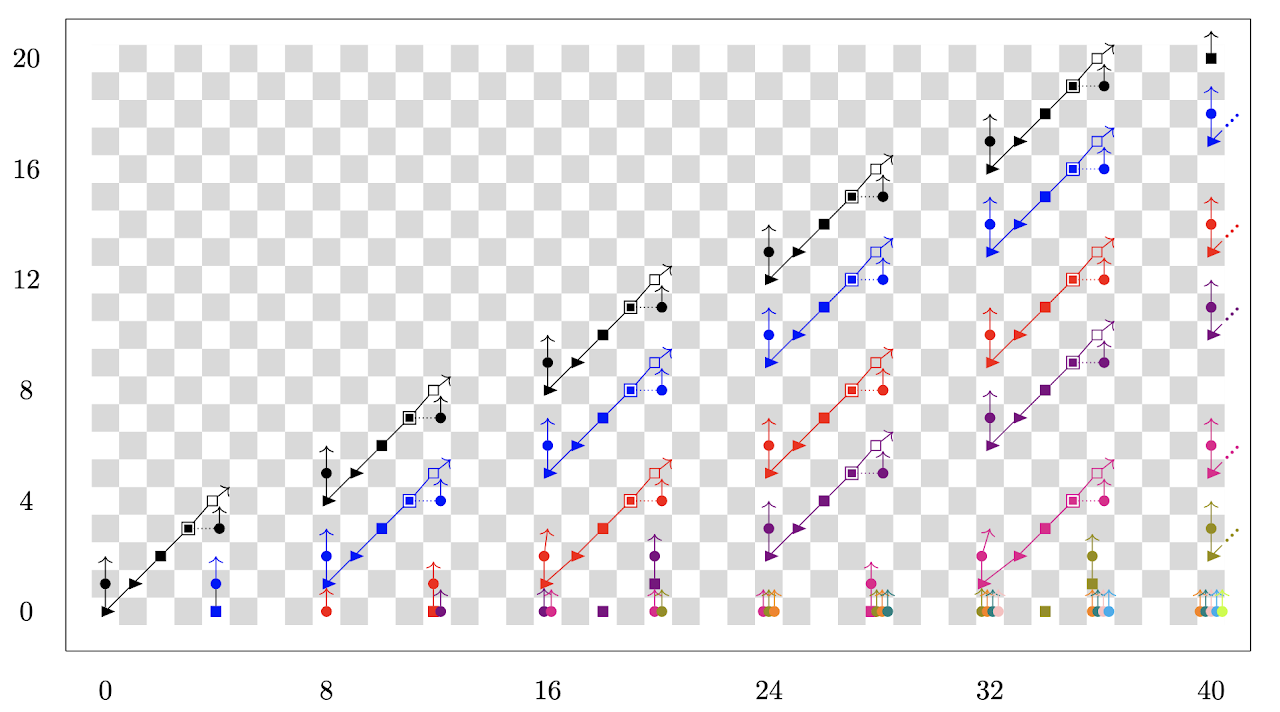
We compute the ring of cooperations for the very effective hermitian K-theory over all finite fields 𝔽q where char(𝔽q)≠2. To do this, we use the motivic Adams spectral sequence and show that all differentials are determined by the integral motivic cohomology of 𝔽q. As an application, we compute the E1-page of the kq-resolution.
2.On the ring of cooperations for real hermitian K-theory
Let kq denote the very effective cover of the motivic hermitian K-theory spectrum. We analyze the ring of cooperations for kq in the stable motivic homotopy category SH(ℝ), giving a full description in terms of Brown–Gitler comodules. To do this, we decompose the E2-page of the motivic Adams spectral sequence and show that it must collapse. The description of the E2-page is accomplished by a series of algebraic Atiyah–Hirzebruch spectral sequences which converge to the summands of the E2-page. Along the way, we prove a splitting result for the very effective symplectic K-theory ksp over any base field of characteristic not two.
1.Toric double determinantal varieties
We examine Li’s double determinantal varieties in the special case that they are toric. We recover from the general double determinantal varieties case, via a more elementary argument, that they are irreducible and show that toric double determinantal varieties are smooth. We use this framework to give a straighforward formula for their dimension. Finally, we use the smallest nontrivial toric double determinantal variety to provide some empirical evidence concerning an open problem in local algebra.
Notes
Higher Real K-theory, redshift, and blueshift
Expanded set of notes for DUBTOP seminar talk.</em>
Splittings and the algebraic Atiyah-Hirzebruch spectral sequence
Expanded set of notes for preseminar talk at UW.
Notice: Section 7.1 has an incorrect E(1)-comodule structure on the Brown-Gitler comodule.
Galois descent and the Picard group of K-theory
Notes for a talk in the UW Student AG Seminar.
Notice: Example 3.2 and Example 4.1 are incorrect! It is not true that Galois extensions of number fields induce Galois extensions of their rings of integers. This is precisely why Example 4.1 is so hard; I forgot about ramification.
The Adams spectral sequence and Hopf algebroids
Notes for a talk in the DUBTOP seminar.
Selected recent talks
- Higher Witt K-theories, YTM, June 2026.
- Higher Witt K-theories, Cascade Topology Seminar, May 2026. Slides
- Cooperations in motivic homotopy theory, Thesis defense, May 2026. Slides
- Splittings and periodicity in motivic homotopy theory, University of Washington Topology Seminar, February 2026
- Cooperations in motivic homotopy theory, JMM, January 2026. Slides
- Splittings and cooperations in motivic homotopy theory, University of Virginia Topology Seminar, November 2025
- Splittings and cooperations in motivic homotopy theory, University of Kentucky Topology Seminar, November 2025
- Higher Adams differentials and hidden extensions, eCHT Secondary Steenrod Algebra Reading Seminar, November 2025
- Splittings and cooperations in motivic homotopy theory, Duke University Geometry and Topology Seminar, October 2025
- Splittings of truncated motivic Brown-Peterson cooperations algebras, University of Colorado Boulder Homotopy Theory Seminar, September 2025
Friends and Collaborators
Keita Allen, Frances Baer, Julie Bannwart, Thomas Brazelton, Maxine Calle, Preston Cranford, Natasha Crepeau, Luca De Paulis, Konstantin Emming, Andrea Figini, Sebastian Gant, Marco Giustetto, Bert Guillou, Manyi Guo, Liam Keenan, Jesse Keyes, Klaus Mattis, Juan Moreno, Matthew Niemiro, Nelson Niu, Morgan Opie, Kyle Ormsby, Sarah Petersen, Lucas Piessevaux, Azélie Picot, Prerna, J.D. Quigley, Ryan Quinn, Jay Reiter, Dominik Schrimpel, Brian Shin, Liz Tatum, Alexander Wang, Alex Waugh, Lucas Williams, Albert Yang, Qi Zhu, Paul Arne Østvær
 |
|---|
| The ring of cooperations $\pi_{**}(\text{kq} \otimes \text{kq})$ over $\mathbb{F}_3$. |